A developer named Gaurav built a tool at blumify.io/people that catalogs public statements from AI leaders and lets users vote for which people get dedicated tracking pages, with the explicit goal of surfacing contradictions in what influential figures say over time. The project grew out of an earlier effort to turn YouTube videos and podcasts into searchable transcripts, and it generated significant discussion on Hacker News, reaching 94 points and 59 comments.
What is Blumify’s people tracker?
Blumify.io/people is a tool that lets users vote for which public figures get dedicated pages tracking their statements over time, with one vote allowed per person per account. The creator, Gaurav, describes it as a byproduct of a separate project focused on turning YouTube videos and podcasts into searchable transcripts, which led him to the broader question of “how do you keep track of what influential people actually say, and how their thinking changes over time.”
What example did the creator give to explain the concept?
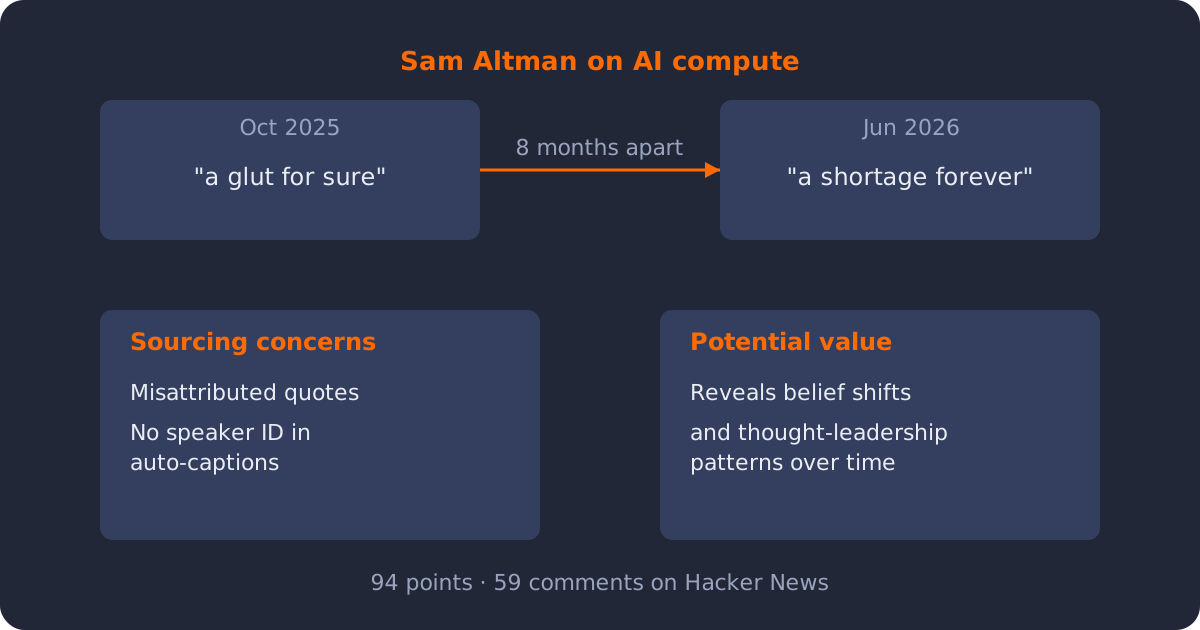
Gaurav used Sam Altman’s shifting comments on AI compute as the flagship example of the tool’s purpose. According to the Hacker News post, in October 2025 Altman said about compute, “there will come a glut for sure,” while in June 2026 he said “there will be a shortage forever” — two statements made eight months apart.
What sourcing problems did commenters flag?
Commenters raised two technical and methodological issues with the current implementation. One flagged a specific sourcing error, and another questioned whether YouTube’s automatic transcription technology is reliable enough for this use case.
As one Hacker News commenter put it: “Quoting a Kai Lentit video as Dario Amodei changing his mind on regulation is peak slop.” A separate commenter noted a related technical limitation: “YouTube’s auto-generated captions are a great product, but one problem is that they can’t tell speakers apart in podcasts with multiple people.”
What would it take for this tool to be trustworthy?
Multiple commenters argued the tool needs far broader coverage to avoid being misleading, since partial records of what someone said can be used to construct misleading narratives. One Hacker News commenter wrote: “Selective ommission and reduction of context would allow any narrative you chose to write… you really need to cover enought scope that it would be surprising to find a public statement that was not covered here.”
Other commenters saw upside despite these concerns, with one suggesting the underlying concept could reveal broader patterns — such as how beliefs spread across societies, measures of thought leadership, or how far ahead the Bay Area is in information diets — that could be useful for things like investment analysis. Another commenter said the idea was interesting but found it hard to evaluate without signing up for an account first.